Study figure and data
48-week tretinoin trial: epidermal thickness change
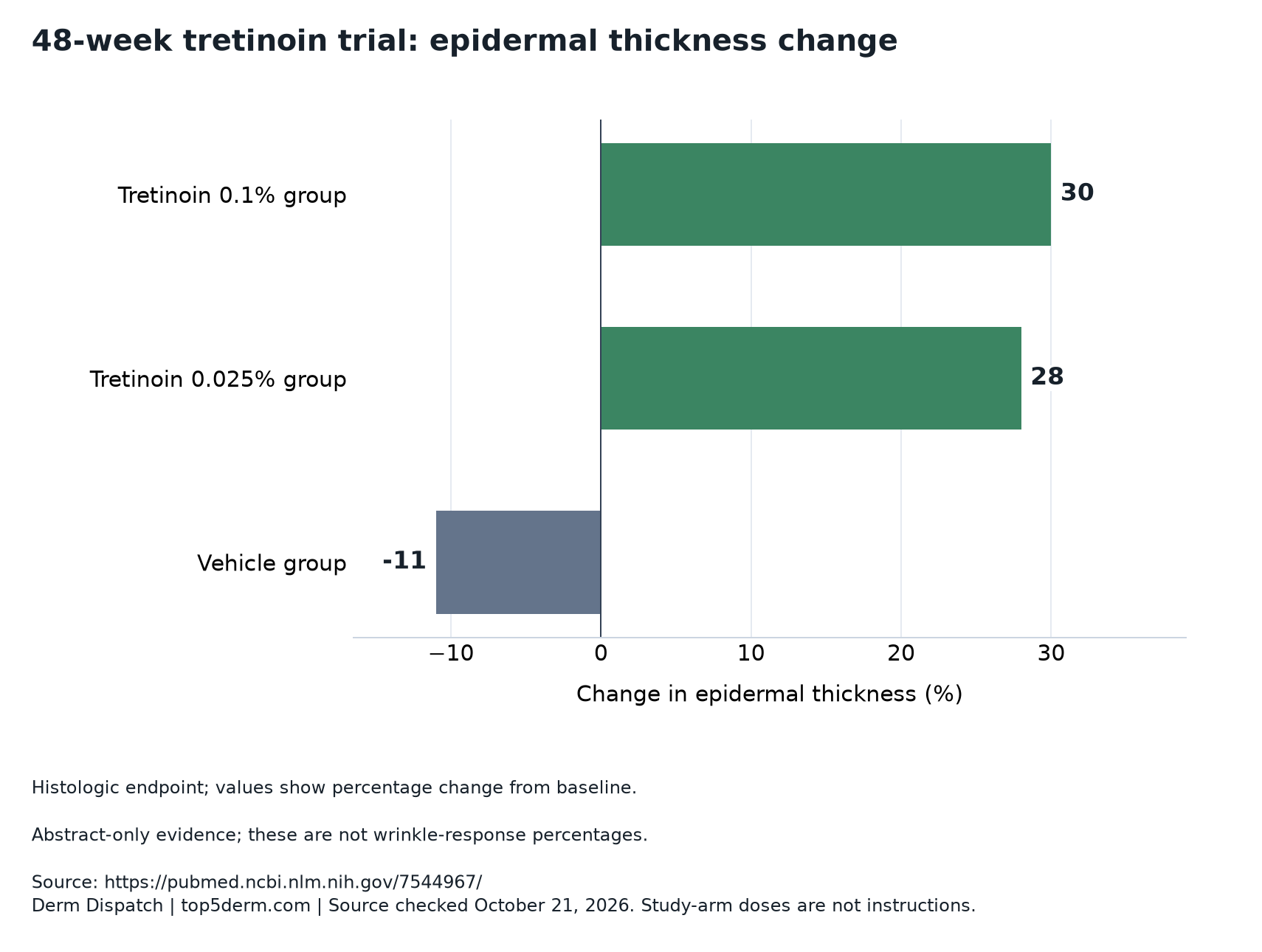
Histologic endpoint; values show percentage change from baseline.
Abstract-only evidence; these are not wrinkle-response percentages.
Download chart (PNG)Download data (CSV)Download vector chart (SVG)
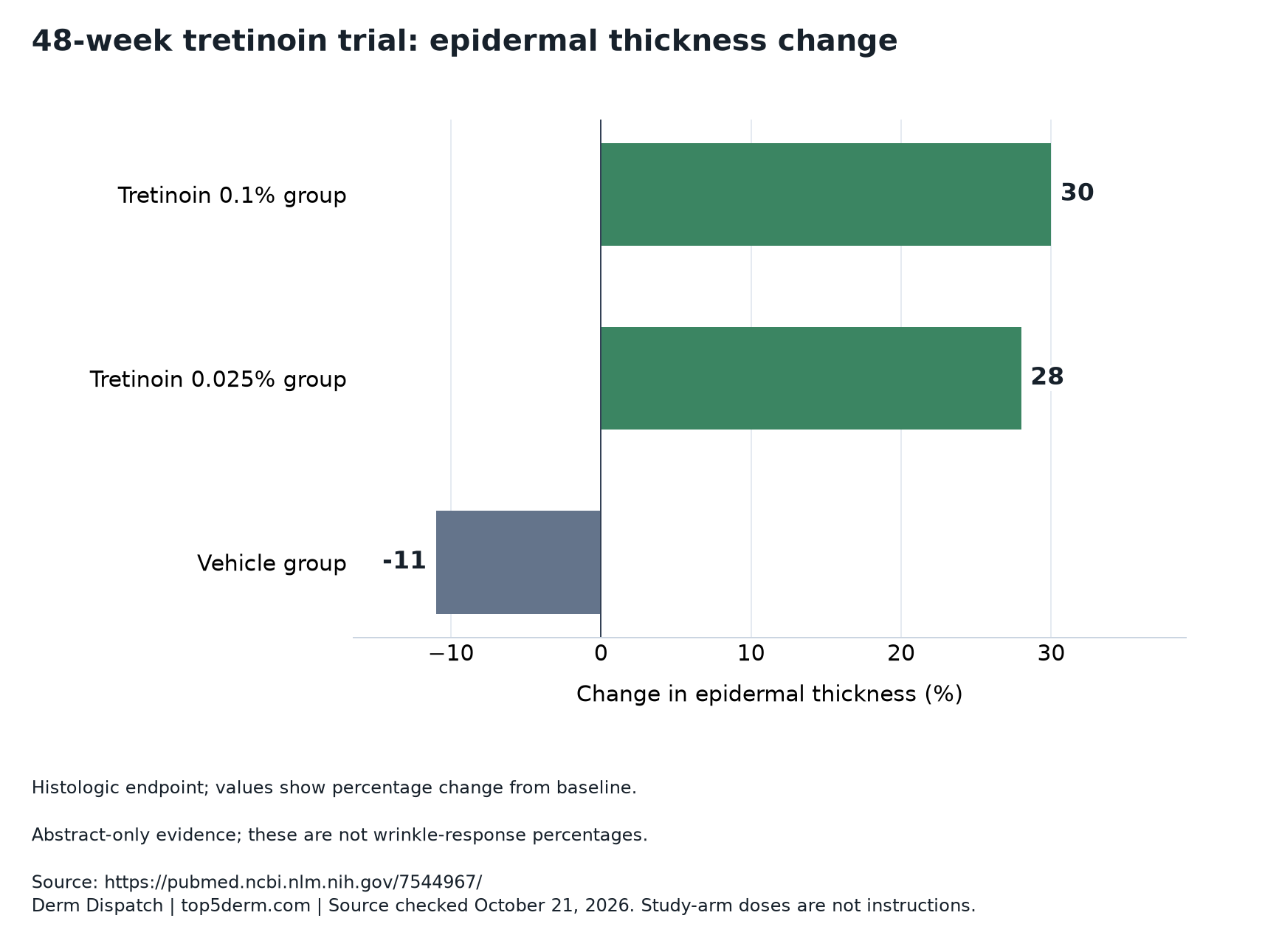
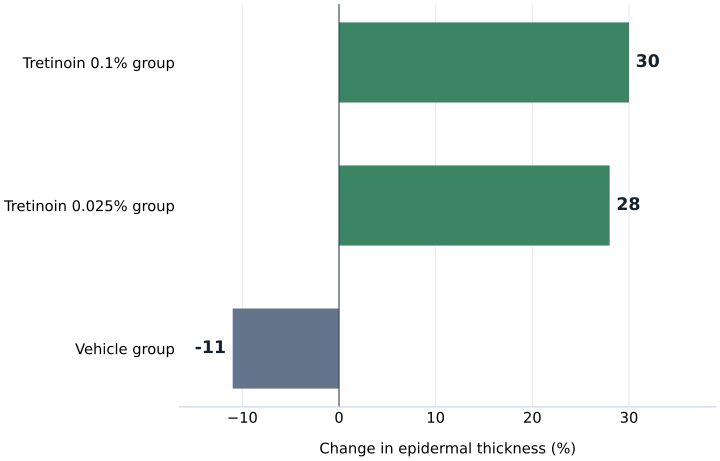
| Study group | Reported value |
|---|---|
| Tretinoin 0.1% group | 30 |
| Tretinoin 0.025% group | 28 |
| Vehicle group | -11 |
Start with the contrast, not the concentration label
The 1995 double-blind, 48-week comparison reports 99 completers: 0.1% tretinoin (32), 0.025% (35), vehicle (32). Both active arms improved facial photoaging similarly versus vehicle; 0.1% caused more redness/scaling. Its indexed abstract leaves enrollment, allocation, attrition, confidence intervals, funding, and biopsy site unresolved.
For interpretation, draw three boxes representing the preparations and connect only the comparisons actually investigated. A line between two active preparations addresses their relative performance under the study conditions. Lines to a shared control help distinguish each treatment from that control. Neither type of line automatically extends to every cream carrying the ingredient name. The concentration is one feature of the treatment represented by a box, not the entire identity of that treatment.
This way of reading also separates a finding from a decision. An editor can describe the observed comparison while withholding a universal first place. The important question is which proposed distinction the evidence resolves, and for which people. Our guide to reading skin-care reviews without a clinical score uses the same documentary discipline: identify the claim before judging whether its supporting evidence reaches it.
Decide what a win would mean to the reader
Imagine planning a comparison before collecting any results. The outcome might be a clinician rating, a participant rating, a measured tissue characteristic, or continued use without unacceptable symptoms. Each captures a different aspect of experience. Choosing one after seeing favorable numbers lets the definition of success follow the result. A stronger design specifies the principal outcome and time point beforehand, while retaining other outcomes as complementary evidence.
The outcome also needs a unit and direction. A lower severity score may be favorable, whereas a larger change in another measurement needs its own interpretation. Merely placing both on a zero-to-one-hundred scale would not make them interchangeable. Transforming units changes the display; it does not establish that equal movements carry equal importance. A useful comparison must connect the measurement to the decision it is meant to inform.
For a ranking, Derm Dispatch would therefore ask for a clinically meaningful difference: a distinction large enough to matter, supported by an appropriate justification. That threshold is not automatically the smallest detectable change or a particular significance level. Readers should be able to see how it was chosen. Without that explanation, first place may mean only that one point estimate happened to be numerically larger.
Similarity needs a precision argument
The absence of a demonstrated advantage and the demonstration of sufficiently similar effects are different conclusions. To establish practical similarity, a comparison needs a defensible tolerance for how far the effects may differ, a suitable analysis, and enough precision to evaluate that tolerance. This is a design question as well as a reporting question. Calling two treatments equivalent after an inconclusive comparison does not supply the missing design.
The table uses entirely invented improvement units, with positive differences favoring preparation A. Suppose an equally invented decision rule considers a difference greater than 0.5 units important. An estimate alone cannot tell us whether that threshold is exceeded. The accompanying interval shows a range compatible with the data and statistical assumptions. Wide uncertainty can accommodate substantially different decisions, even when the central estimate looks modest.
These examples are not calculations from the tretinoin reports. They show why a ranking needs the between-treatment difference and its uncertainty, rather than separate significance labels. Even a precise advantage on the chosen measure would leave questions about its applicability and tolerability. For context on the categories being compared, the retinoid-options guide provides a separate starting point; a category description is not a comparative effect estimate.
| Invented estimate | Hypothetical 95% interval | Interpretation under the illustrative 0.5-unit rule |
|---|---|---|
| 0.2 units | −0.9 to 1.3 | The interval includes important advantages in either direction. |
| 0.2 units | −0.1 to 0.5 | The estimate favors A, but the interval includes zero. |
| 0.8 units | 0.6 to 1.0 | The entire interval exceeds the invented importance threshold. |
A percentage does not identify the benefit
Read the scientific chart by following the named measurement and its baseline, rather than treating a longer bar as a general measure of better skin. A percentage change has a denominator: the starting quantity used to calculate it. A clinical score, the proportion of people reaching a response threshold, and a physical measurement each have a different denominator or scale. Their shared use of numbers does not provide a conversion between them.
Consider an explicitly fictional laboratory quantity that rises from 50 to 60 units. Its relative increase is 20%, while the absolute increase is 10 units. A second quantity rising from 100 to 110 units changes by the same absolute amount but only 10% relatively. Neither calculation tells us how a person would rate appearance or comfort. That would require a measured relationship with the relevant experience, not an arithmetic relabeling.
The same distinction matters when selecting evidence for an ordering. A tissue result might motivate a biological hypothesis and help explain what investigators measured. To rank clinical benefit from that result, one would need evidence that differences in the tissue measure reliably represent differences in the clinical outcome. An appealing biological account alone does not validate that substitution. Keep both measurements visible instead of making one stand in for the other.
Check whether the controls permit the proposed comparison
A shared word such as vehicle can conceal an important comparison question: are the controls sufficiently comparable for the inference being attempted? The vehicle is the formulation used as the comparison preparation without the studied active treatment. Within a properly designed comparison, it helps define the added effect being investigated. Across separate studies, simply naming a vehicle does not establish identical backgrounds, populations, measurement methods, or follow-up.
An indirect ranking would need to examine those connections. Suppose one fictional study compares A with control X and another compares B with control Y. Subtracting the reported improvements does not isolate A versus B unless the relevant differences between the studies are adequately addressed. Even a common control name would not eliminate that requirement. The question is whether the evidence network supports the intended comparison, not whether two studies both contain a control arm.
The table is an editorial planning template, not a grading system for existing products. It makes the missing comparison explicit before any ordering is attempted. The prescription-retinoid route comparison can help organize documentary questions about options; its practical categories should remain separate from the scientific comparisons that would be needed to establish relative efficacy.
| Proposed comparison | Evidence to match | Question still needing an answer |
|---|---|---|
| Two finished preparations | Population, outcome, timing, and care conditions | Was the difference tested directly with adequate precision? |
| Separate studies with controls | Control composition and factors that could alter effects | Are the studies sufficiently comparable for an indirect estimate? |
| Ingredient evidence applied to a product | Formulation, route, exposure, and intended population | What supports transferring the result to this preparation? |
| Benefit combined with tolerability | Outcome definitions and explicit priorities | Whose preferences determine the weighting? |
Keep irritation and missing outcomes in the comparison
A benefit ranking that ignores tolerability answers only part of the practical question. Yet subtracting a symptom count from an efficacy score is not an objective correction: the units differ, and the subtraction imposes an unstated preference. A more interpretable presentation shows benefit and unwanted effects separately, then explains any decision rule used to weigh them. Different readers may reasonably place different importance on the same trade-off.
Withdrawal also changes what a result describes. In an invented example, suppose preparation A has favorable ratings among those who remain, while several participants leave without final measurements. We would need to know the reasons, timing, and analytical handling of those absences before interpreting the apparent advantage. Missing outcomes could have several explanations. Assuming either success or failure for every missing participant would add information that was never observed.
A useful analysis can examine whether conclusions change under plausible assumptions about missing values. This is a sensitivity analysis: a deliberate test of dependence on those assumptions. Completion counts alone do not perform it. Likewise, irritation is not itself proof that a treatment is working, nor does a benefit comparison establish its biological cause. A causal explanation would require evidence designed to distinguish competing mechanisms, with attention to timing and alternative explanations.
Use another study to test the boundaries of the question
Kafi’s randomized study enrolled 36 adults averaging 87 and compared laboratory 0.4% retinol with vehicle on paired upper inner arms over 24 weeks. Twenty-three completed; three withdrew for irritation/pruritus. Its full article reports an intention-to-treat analysis carrying earlier observations forward. Four inventors disclosed conditional royalty interests, not proven payments.
The paired structure provides a different way of making a comparison: each participant contributes observations from both treatment conditions. The analysis needs to account for that relationship. Treating the two sides as unrelated samples would discard an important feature of the design. It also means that uncertainty for a treatment difference cannot generally be reconstructed by casually subtracting the limits of two separate intervals.
Our retinol study analysis develops that example on its own terms. The methodological lesson here is to preserve the study’s question when bringing it into a wider discussion. Ingredient, preparation, location, population, and outcome each help define the contrast. A broader ranking would need a justified bridge between those features, rather than an assumption that any study involving aging skin supplies another directly comparable entry.
Longer observation answers a different dimension of performance
The 2005 randomized trial treated 204 people with 0.05% tretinoin emollient cream or vehicle for up to two years. Its abstract reports clinical improvement without numerical effect sizes. The accessible acknowledgment identifies OrthoNeutrogena support and Johnson & Johnson employment/equity and research/consulting ties; complete methods and results were not reviewed.
Duration deserves its own place in an evidence comparison. A result observed at one time point does not describe the whole response over time. A longer investigation may help answer whether particular effects remain observable, but it does not automatically establish a larger benefit than a shorter study of something else. To make that claim, one would need comparable outcomes and an analysis that addresses the differing observation periods.
Imagine two fictional trajectories that cross: one changes earlier, the other later. A ranking based on an early assessment could differ from one based on a later assessment without either calculation being arithmetically wrong. The error would be hiding the time horizon. Questions in mature-skin care discussions should therefore include what outcome matters and when it is assessed. Histologic observations, visible change, and long-term clinical harms also remain separate outcomes; evidence concerning one does not automatically settle the others.
A product label defines a narrower claim than an ingredient name
Current RENOVA labeling concerns 0.02% cream as an adjunct for fine facial wrinkles with comprehensive skin care and sunlight avoidance. It does not claim reversal of photoaging. Its evidence limits beyond 52 weeks and above age 71 belong to that product. It warns against use during pregnancy or attempts to conceive.
This is why a formulation belongs in the comparison question from the start. A clinical report about an active ingredient does not, by itself, supply approval or outcome evidence for every preparation containing it. Nor can one product’s label be treated as a catalog of established benefits for another. A defensible transfer would identify what is the same, what differs, and what evidence addresses the significance of those differences.
The guide to choosing a skin-care category is useful before comparing individual offers. Our editorial interpretation is that readers benefit from distinguishing the medical question from the purchasing question: an accessible service and a scientifically established effect are different attributes. A qualified clinician can assess suitability using the actual product information and a person’s medical history. Historical study exposures identify the investigated treatments; they do not provide an individual plan or justify changing one.
Make the final ordering accountable to its evidence
Before publishing an efficacy ranking, an editor should be able to explain every move from evidence to position. Which finished products are compared? Which population and outcome does the comparison concern? What is the estimated difference, how uncertain is it, and what threshold makes it meaningful? If tolerability or access changes the ordering, the weighting needs to be visible rather than hidden inside a clinical-looking score.
Funding and financial interests belong in that account because readers should be able to inspect relationships that could affect research decisions. A disclosed relationship is not, on its own, proof that a result is false. Conversely, calling a study controlled does not remove the need to examine outcome selection, missing data, and reporting. The assessment should consider the methods and the disclosed relationships together without substituting one for the other.
For documentary checks, the CoreAge Rx Smooth Move review and Dermatica Personalized Formula review are separate places to examine terms described in those reviews. These links assign neither provider a clinical result. Our editorial conclusion is to publish a clear comparison question and its supporting evidence before publishing a rank. When the evidence does not resolve an ordering, an explicit unresolved comparison is more informative than an unexplained score.
Questions about the evidence
Could two creams be ranked if both studies report statistically significant improvement?
Not from that information alone. Each significance test concerns a particular comparison and statistical model. The ordering would require evidence about the difference between the creams on a comparable outcome, including its uncertainty. Two favorable comparisons against controls do not automatically establish which active preparation performs better. A suitable indirect analysis may sometimes be possible, but its assumptions need to be examined.
Does a narrow confidence interval make a difference important?
It makes the estimate more precise under the analysis assumptions, which is a different property. An effect can be precisely estimated yet too small to matter for the intended decision. Importance needs an independently justified threshold or interpretation. Conversely, a large point estimate with wide uncertainty may leave the decision unresolved. Both magnitude and precision belong in the assessment.
Should irritation simply lower the efficacy score?
That would combine two different outcomes using a value judgment. A clearer starting point is to report benefit and tolerability separately. Any combined decision score should explain its units, weighting, and intended users. Otherwise, readers cannot tell whether a lower position reflects a weaker measured effect, more unwanted symptoms, a preference about those symptoms, or missing information.
Can a laboratory finding explain which cream will look better?
It can support a hypothesis, but prediction requires evidence linking the laboratory measure to the clinical outcome in the relevant setting. A relationship within one study is not automatically a reliable rule across treatments. Before substituting a biological measurement for visible improvement, ask whether changes in that measure consistently capture the treatment differences that readers actually care about.
What information should accompany a responsible comparison page?
State the population, finished preparations, comparison condition, outcome, time horizon, and accessible evidence. Separate estimated effects from missing information and explain any weighting of benefit and unwanted effects. Documentary details about a service can then sit alongside that assessment with their own dates and sources. They should not be presented as proof of an efficacy ranking or a personal treatment recommendation.
Editorial assessment
Derm Dispatch’s assessment is that the scientific question should determine the comparison format. An ordered list is appropriate only when the evidence and explicit decision rules support the distinctions it displays. Otherwise, a structured account of outcomes, uncertainty, tolerability, and applicability gives readers more usable information. The most useful next evidence would address the precise unresolved comparison: matching finished preparations, an agreed clinical outcome, adequate follow-up, and analyses that retain uncertainty and account for missing observations. Until those connections are demonstrated, ingredient percentages and isolated favorable results do not justify a universal efficacy order.
Research access and limitations
This article provides methodological interpretation, not a treatment ranking or individual prescription. The cited records have different access boundaries, documented beside each reference. Invented examples explain comparison logic and are not study results. No provider outcomes, equivalence margins, or numerical clinical advantages are inferred where they have not been established.