Study figure and data
24-week retinol study: fine-wrinkle change
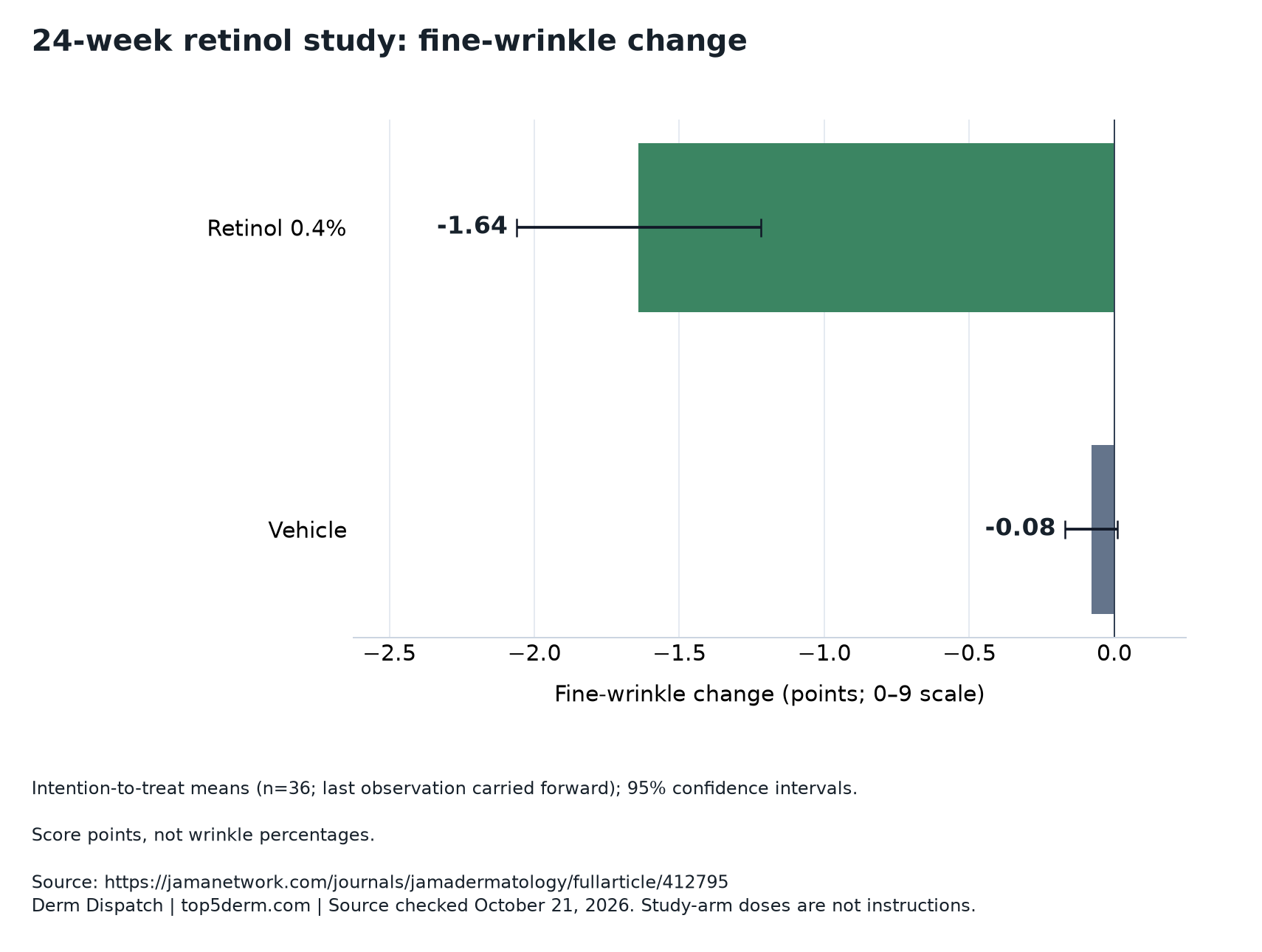
Intention-to-treat means (n=36; last observation carried forward); 95% confidence intervals.
Score points, not wrinkle percentages.
Download chart (PNG)Download data (CSV)Download vector chart (SVG)
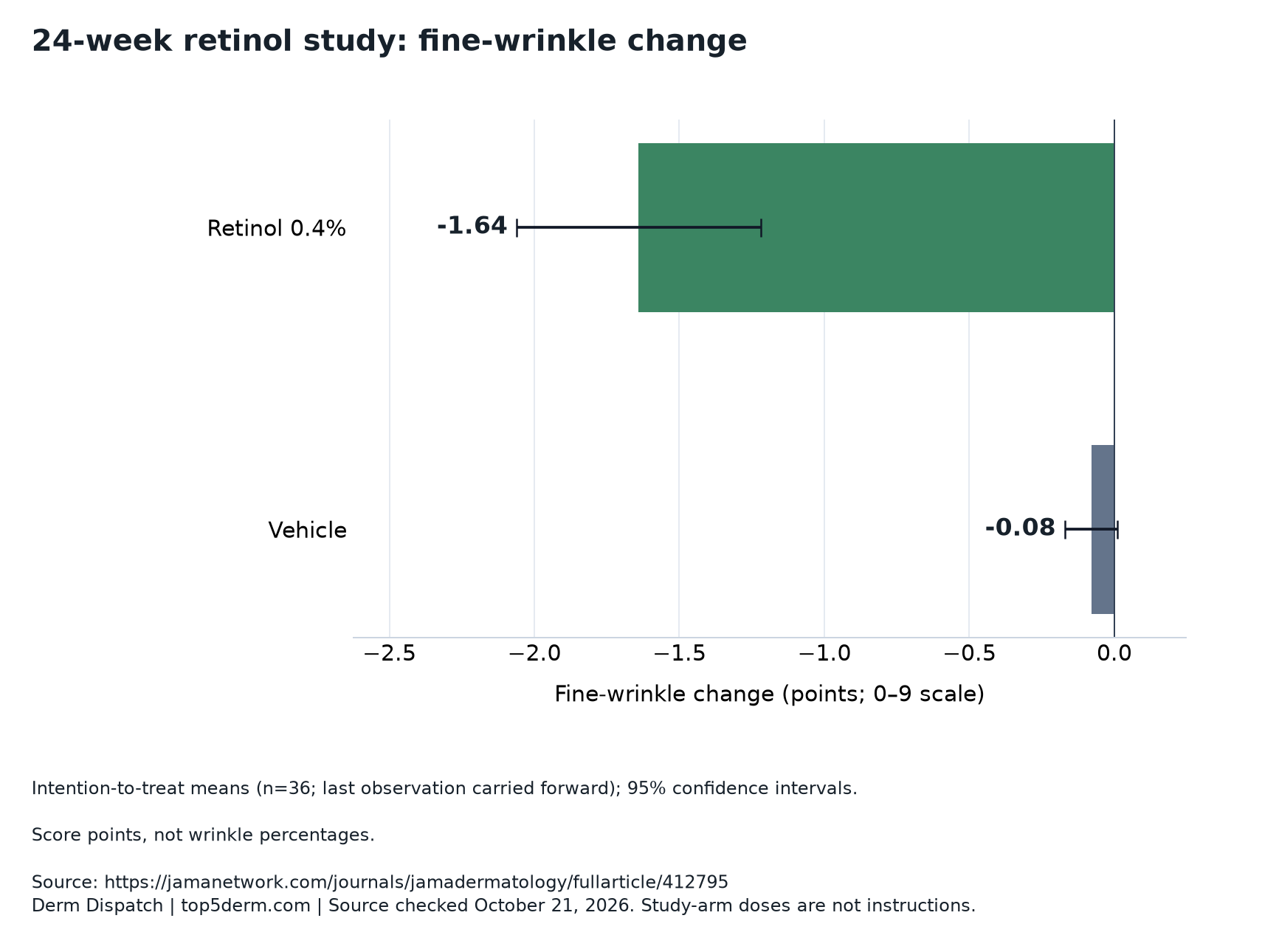
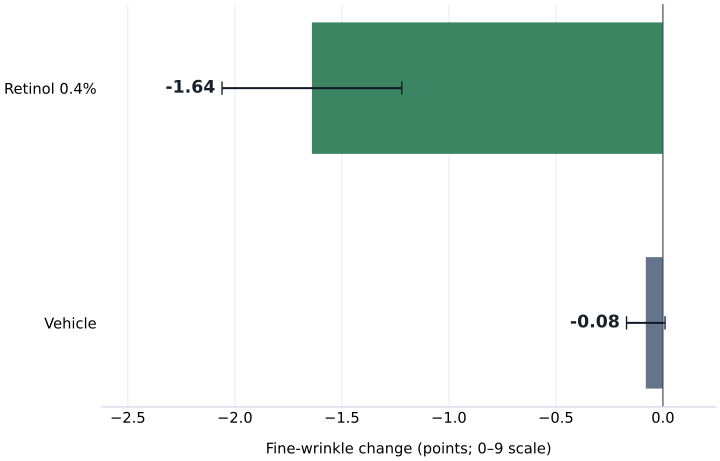
| Study group | Reported value | 95% confidence interval |
|---|---|---|
| Retinol 0.4% | -1.64 | -2.06 to -1.22 |
| Vehicle | -0.08 | -0.17 to 0.01 |
Specify the contest before ordering the options
A useful efficacy question has several parts: the people of interest, the treatment strategy, the alternative, the outcome and the assessment date. These choices define what the comparison means. A cream could rank differently for visible improvement than for the likelihood of continuing treatment comfortably. Neither ordering would automatically be wrong, but calling both “best” would conceal the change in question. Write the intended comparison in one sentence before looking at its result.
Consider an invented evaluation in which investigators want to compare two finished creams for a visible change assessed at a fixed visit. They would need the same scoring rules for both products and a plan for people who stop using them. If they instead measure one cream after a brief course and the other after prolonged use, a simple order merges treatment differences with time differences. Our guide to reading skin-care evidence offers a starting point for separating the clinical question from the presentation of a product review. A defensible order should remain understandable after its marketing language is removed.
Keep the person inside the paired comparison
A paired design asks a within-person question. Rather than comparing the average result in one collection of people with the average in another, it compares corresponding measurements from the same person. Characteristics shared by the two sites are therefore held together in the comparison. Random allocation of the treatments to sides also helps prevent a systematic preference for one side from deciding the result. This does not remove every possible source of error: evaluation, treatment differences and missing measurements still matter.
The unit of reasoning is the pair, not an isolated treated surface. Two arms do not create two independent people. Imagine that a participant experiences a general change that affects both sites equally. A comparison of that person’s sites can subtract out the common change, whereas an analysis that treats every site as unrelated ignores useful information. This is why the design belongs beside the outcome rather than in a distant footnote. Our mature-skin care comparison can help organize different care questions; it should not be read as replacing the population and body-site definition of a clinical experiment.
Read the score as a measurement rule
A clinical grade is a way of turning an observation into an ordered measurement. Its units need interpretation before its changes can guide a ranking. A movement of one point on an assessment scale is not automatically a fixed proportion of wrinkle area, a count of wrinkles removed or a patient’s estimate of visible improvement. Those are different outcomes. Even when arithmetic permits dividing a change by a baseline score, the resulting fraction may not describe a meaningful physical quantity.
The next question is whether the separation matters to a person, not merely whether it can be distinguished statistically. In an invented example, two creams might differ by a small fraction of a grade while both produce changes that users find worthwhile. Alternatively, a larger average difference could hide substantial variation in individual experience. A ranking should explain the threshold it treats as meaningful and how that threshold was chosen. Our retinoid category guide helps distinguish treatment categories before this measurement question is applied. A shared category name is not a common outcome scale, and a precise decimal does not settle the importance of the difference.
Separate the estimated effect from its precision
An estimate gives a location on the measurement scale; a confidence interval describes uncertainty around an estimate under the analysis assumptions. Neither is a complete ordering rule. A narrow interval around a small difference can be more statistically decisive than a wide interval around a larger difference. To evaluate an efficacy ranking, consider both the size of the effect and the range of effects compatible with the analysis. Precision alone does not make an outcome important.
For a paired comparison, uncertainty about the difference depends on how the two measurements move together. As a purely illustrative calculation, suppose each site’s estimate has a standard error of one unit. If their correlation is zero, the standard error of their difference is about 1.41 units; if their correlation is 0.5, it is one unit. These invented values demonstrate why subtracting the ends of two separate confidence intervals does not construct the paired difference’s interval. The two site estimates and their relationship must be considered together. Reading the displayed intervals as though they represented independent competing products would discard the very structure that makes a paired experiment informative.
Ask what happens after a measurement is missing
An intention-to-treat analysis aims to retain the treatment assignment in the analysis. It does not mean that every participant supplied every planned observation. Last observation carried forward is one method of filling a later gap: an earlier available measurement is used again. This makes a numerical analysis possible, but the repeated value remains an assumption about an unobserved outcome. It should not be mistaken for a new examination of the person.
Suppose, in an invented example, that a participant improves at an early visit and then leaves. Carrying that score forward would preserve the early improvement. If the person later worsened, the replacement would be too favorable; if improvement continued, it would be too unfavorable. The direction is not settled by the method’s name. For ranking purposes, ask whether plausible alternative assumptions could change which treatment appears ahead. Also distinguish an analysis of everyone assigned from an analysis restricted to those who finish. Those approaches may address different questions when completion is related to treatment experience. A clear account of missingness is part of the result, not an optional administrative detail.
| Analysis choice | Question it raises | Evidence needed |
|---|---|---|
| Carry an earlier value forward | Could the unobserved value differ? | Sensitivity analyses under plausible alternatives |
| Analyze only finishers | Who remains represented? | Reasons for missingness and comparison with those retained |
| Compare treatment policies | Does stopping count in the outcome? | A stated rule applied consistently to both options |
Compare finished preparations, not ingredient names
A vehicle comparison is designed around an active preparation and its corresponding base. It helps ask what is added by the treatment under those conditions. It does not establish a chain of equality between every product containing the named ingredient. To compare two finished preparations, an investigator would need to define both preparations and the circumstances of use. Concentration is one descriptor; it cannot stand in for the complete identity of the intervention.
Here is an original thought experiment. Two products carry the same ingredient percentage, but one is evaluated with a different base, storage arrangement and application policy. If their outcomes differ, attributing the entire difference to the active ingredient would skip several competing explanations. A direct comparison could test the complete products as offered, while a more controlled experiment could isolate a particular formulation change. These are useful but distinct scientific projects. Our comparison of retinoid routes is a way to organize documentary differences before asking whether any clinical evidence actually compares those options. A review should make the match between the tested preparation and the proposed product explicit rather than imply it through a familiar ingredient name.
Include the treatment experience in the efficacy question
A study’s planned treatment and the treatment people actually receive can differ. If applications are withheld because of reactions, the observed outcome belongs to that managed treatment policy. It cannot simply be relabeled as the result of uninterrupted exposure. An efficacy ranking needs to state which policy it is comparing, especially when the ability to continue is part of the practical question.
One useful original distinction is between improvement under an assigned policy and improvement among those who tolerate every planned application. The first incorporates more of the experience of starting; the second describes a selected group. Neither can silently replace the other. A single score that combines benefit and discomfort also needs an explicit weighting rule: how much visible improvement is considered worth a particular burden, and whose preferences determine that exchange? Our moisturizer guide addresses the role of supporting care. Adding a support product to a routine, however, should not be treated as an unmeasured guarantee that a particular treatment will become tolerable.
Do not turn a tissue signal into a functional rank
A biopsy assay and a visible clinical assessment observe different things. A molecular or staining signal may make a biological explanation more plausible without establishing how much visible change it causes. Procollagen staining, for example, is not itself a measurement of resistance to injury. Ulcer prevention was not measured. To test a proposed protective effect, investigators would need a defined functional outcome, a suitable comparison and enough follow-up for that outcome to be observed.
Selective presentation of statistically significant measurements also changes how a collection of positive signals should be read. An original analogy is a page showing only the successful answers from a longer exercise: the displayed answers may be correct, but they do not reveal the whole exercise. Ask how many outcomes were examined, which were specified in advance and how uncertainty was handled. An assay subset cannot supply the same breadth of evidence as complete clinical follow-up merely because its result is statistically significant. The companion analysis of the tretinoin concentration trial examines a different measurement problem. Tissue measurements and visible outcomes should remain separate entries in an evidence assessment until an appropriate study connects them.
Build a comparison that can survive different studies
The 1995 tretinoin abstract reports similar clinical improvement with two concentrations but more irritation with the higher concentration. It does not establish formal equivalence. The 2005 randomized study treated 204 people with 0.05% emollient cream or vehicle for up to two years. These are separate comparisons. Our access to the latter comprises its abstract and publisher acknowledgment, not the complete methods and results.
Placing findings beside one another is useful for locating gaps, but it does not create a common experiment. An indirect comparison would require defensible assumptions about the populations, controls, measurements and follow-up. A common word such as “vehicle” is not sufficient evidence that the controls are interchangeable. Likewise, ordering studies by their P values would mix effect size with precision and study design. The official RENOVA 0.02% label addresses adjunctive mitigation of fine facial wrinkles with comprehensive skin care and sun avoidance; its evidence limits above age 71 and beyond 52 weeks are specific to that product. The editorial task is to preserve these boundaries while identifying the evidence a genuinely shared comparison would need.
| Proposed shortcut | Missing comparison | A more useful question |
|---|---|---|
| Sort by ingredient percentage | Finished preparations under comparable conditions | Which complete interventions were evaluated? |
| Sort by statistical significance | Effect size and uncertainty on a shared outcome | How large and how precise is the difference? |
| Sort by study duration | A common time horizon and population | What happens at the same assessment point? |
| Sort by biological markers | A meaningful clinical or functional outcome | Does the measured change answer the intended question? |
Keep evidence quality separate from commercial convenience
Four inventors disclosed conditional royalties; funding was not separately identified. For the 2005 study, the acknowledgment names OrthoNeutrogena support and reports Johnson & Johnson employment, equity and other pharmaceutical research or consulting relationships. Disclosures help readers identify interests that deserve scrutiny; they do not, by themselves, prove a result false or establish the size of any bias. The useful response is to examine the comparison, reporting choices and availability of evidence that could challenge the conclusion.
Our editorial interpretation is to keep a separate decision ledger for clinical evidence and service terms. A product could be easy to obtain while its comparative efficacy remains uncertain; strong experimental evidence would not by itself tell a reader the terms of a subscription. The Curology HydroTret Rx review and Dermatica Personalized Formula review can be used to check documented offer details. Those links do not imply that either service supplies the studied preparation or reproduces its outcomes. Keeping the two ledgers visible makes a review more useful: readers can compare the documentary features that are actually available without receiving a manufactured clinical score.
Questions about the evidence
Does a lower P value mean a cream deserves first place?
No. A P value is evaluated within a particular statistical comparison and its assumptions. It is not a scale of practical benefit. An ordering needs the magnitude of a difference, its uncertainty and an outcome that matters for the intended population. Comparing P values from unrelated experiments does not supply those missing elements.
Can the graph tell me what an individual will notice?
A group estimate describes an analyzed group, not a promise to each person. It also uses the study’s measurement rule. To discuss individual experience, a reviewer would need information about the distribution of outcomes and their practical meaning. A visually precise plot should not make the prediction sound more personal than the evidence permits.
Why keep treatment withdrawals beside the outcome?
Because a ranking may change meaning depending on whether it describes everyone who starts or only those able to continue. Improvement and treatment burden need to be interpreted together, with a stated analysis policy. Keeping them separate until that policy is clear avoids assigning an unexplained exchange rate between comfort and an efficacy score.
Would a large head-to-head study settle every comparison?
It could answer an important defined comparison, but its usefulness would still depend on the population, formulations, outcome, duration and handling of missing data. A large study of the wrong question does not become the right study through size alone. Precision helps resolve uncertainty within a design; it does not remove the need to specify that design.
What should a reader ask when a list presents a clinical winner?
Ask for the comparison sentence: which complete products, in which people, measured how and when? Then ask whether the claimed difference is meaningful and whether the analysis accounts for treatment burden. If the list instead compares availability, refill arrangements or price, it should identify those as the basis of its order rather than imply a tested efficacy hierarchy.
Editorial assessment
A credible cream ranking needs more than a positive study attached to an ingredient. It needs a stated comparison, a meaningful outcome, interpretable uncertainty and evidence about the complete preparations under comparable conditions. Our reading keeps the experimental result available while refusing to fill the remaining comparisons with invented scores. The next useful research question is not simply whether another treatment produces a favorable measurement. It is whether a carefully defined alternative performs differently, by an amount that matters, for the people and treatment experience the ranking claims to represent.
Research access and limitations
This is an editorial interpretation of the cited evidence, not a product ranking or an individualized treatment plan. Worked numerical examples are hypothetical. Study findings, official labeling and commercial offer documentation answer different questions.